My Journey in making Custom PCB's
I think what really started this whole thing was me getting a Raspberry Pi 4b; Thinking back I didn't really have a good reason to get one, but it's changed everything in the way that it opened a world that I felt was inaccessible, the hackerspace\hardware\electronics spaces specifically.
If I got this when I was a curious kid, I would have had a portfolio of instruments\devices by the time I'd graduate high school is all I'll say about this thing.
getting into microcontrollers, teensy + rp2040
While exploring everything about the single board computers, I learned about microcontrollers. Things like Arduinos, the two that I settled on for learning this platform were the Teensy 3.2 and the Raspberry Pi Pico.
making a simple chord device
The real charm of working with these things is that with some wire you can make whatever your creativity takes you, it's like lego blocks that bridge code to the physical reality and skirts around some fundamentals like the old magic that is Electrical Engineering.
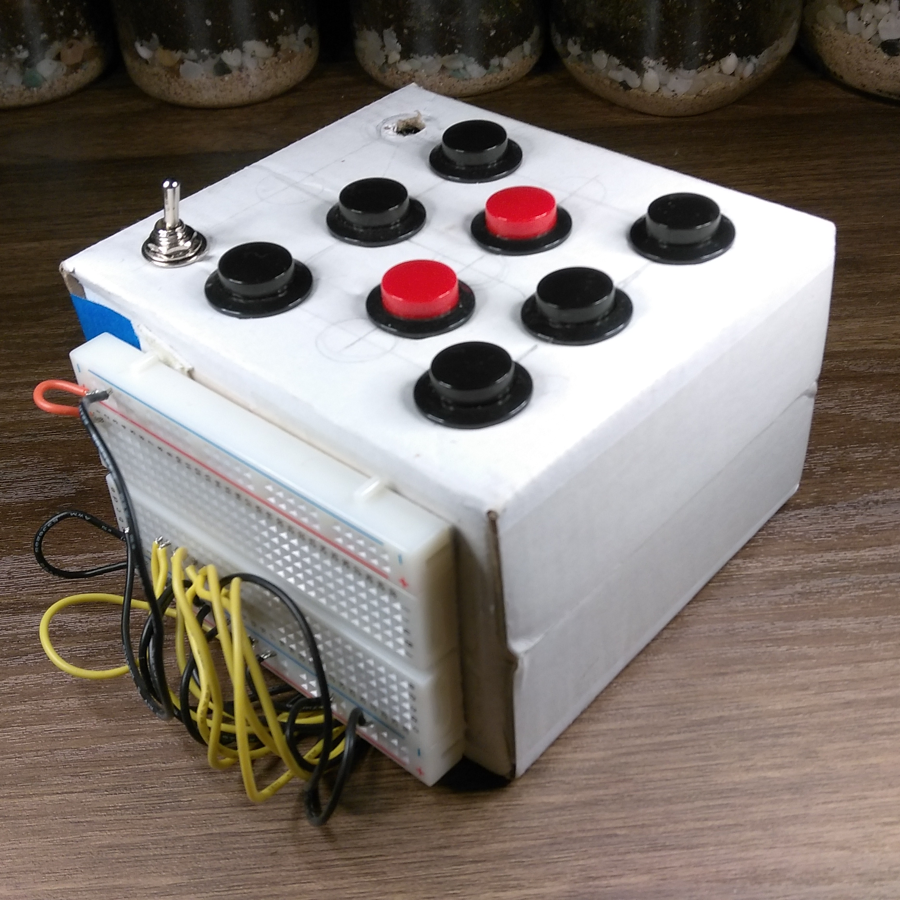
I'll try to explain with one of the first projects I made; Using the teensy 3.2 microcontroller, I cut up some wire and with a breadboard connected it to small arcade buttons, put it all on a wood box I stained for a finish with a silver pen have a device that played a collection of chords as a USB MIDI controller, there was also a switch for single note mode so that I could use it as a 'clip launcher' in Ableton Live. As for code, it uses python, one of the most easiest languages to learn how to read and edit.
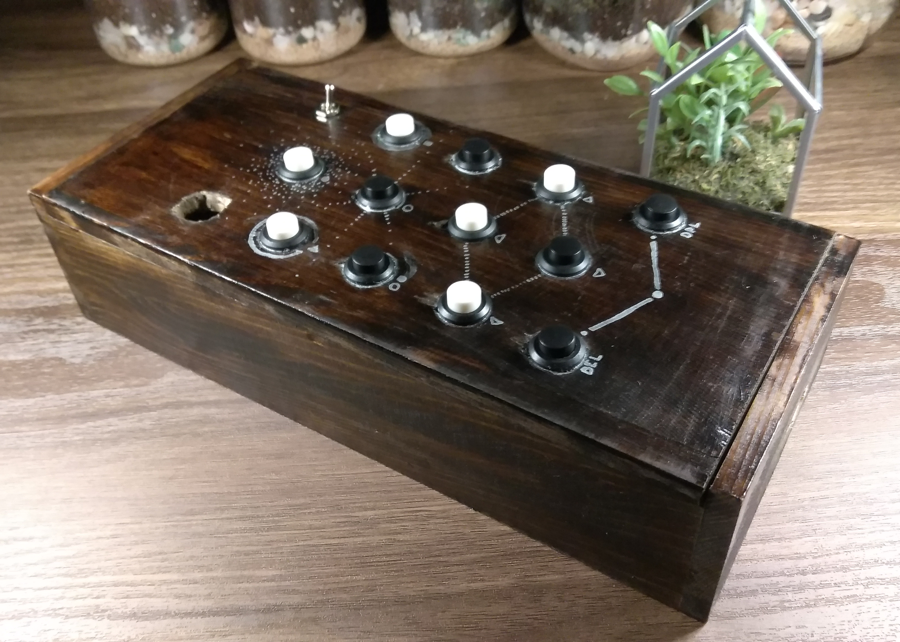
With the Teensy microcontroller I was able to get a super cursory intro to schematic reading\writing. Also just making something physical, not just software was really exciting.
finding out about easyCAD
The thing that I felt limited by was the pin counts on the microcontrollers. If I wanted to make a device that had a bunch of buttons\switches\led's it was only to a few dozen at most. Learning about key matrixes was a game changer in that using the behavior of electricity, a diode and using logic to be able to use only the sum of the row and column amount of pins for the product of its buttons. *So for example I could get 36 buttons using only (6 pins for each row) + (6 pins for each column); 12 pins in total.
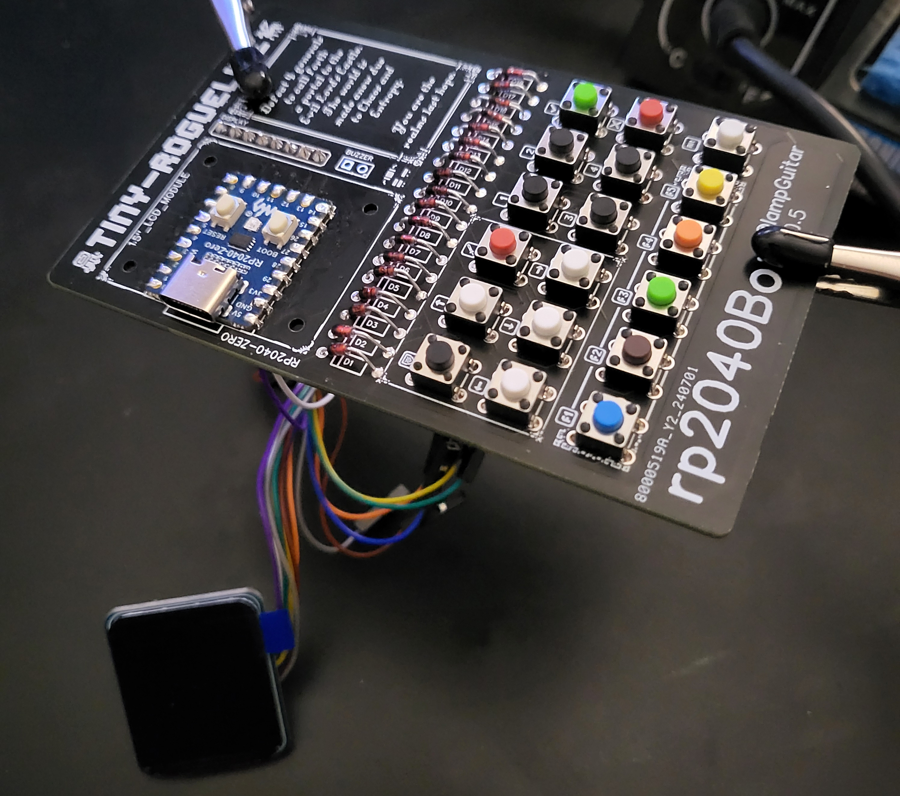
Thinking about hand wiring it though sounded impossible and I found a free tool online called easyCAD which is software to make schematics and then the PCB where you wire it up and also you conveniently have the option to fork some cash to get that PCB made and delivered to you.
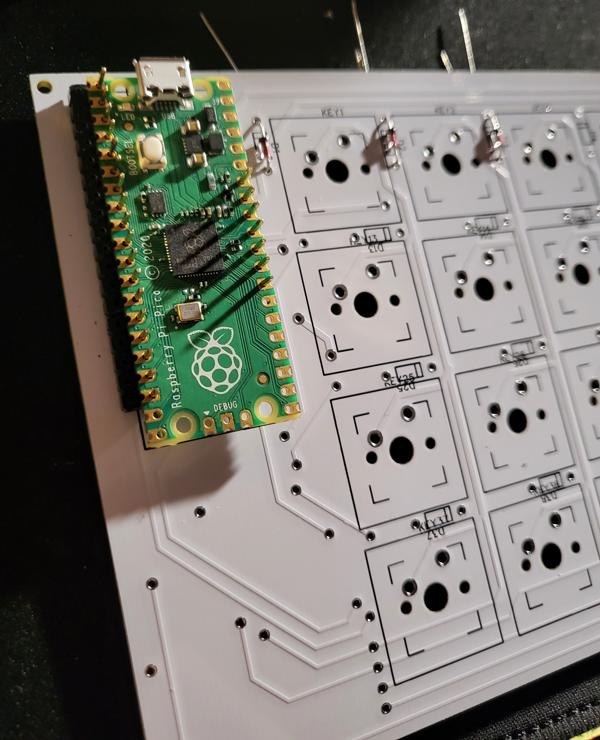
Absolutely game changing, the perks of a globalized world, truly. For the price of a nice dinner, I could have the tools to schematic\pcb\manufacture\ship in one website. Hot damn.
making a macro keypad
Among the first things I got made was a big keyboard which didn't work because I wired it wrong in the software; And a macro pad which worked.
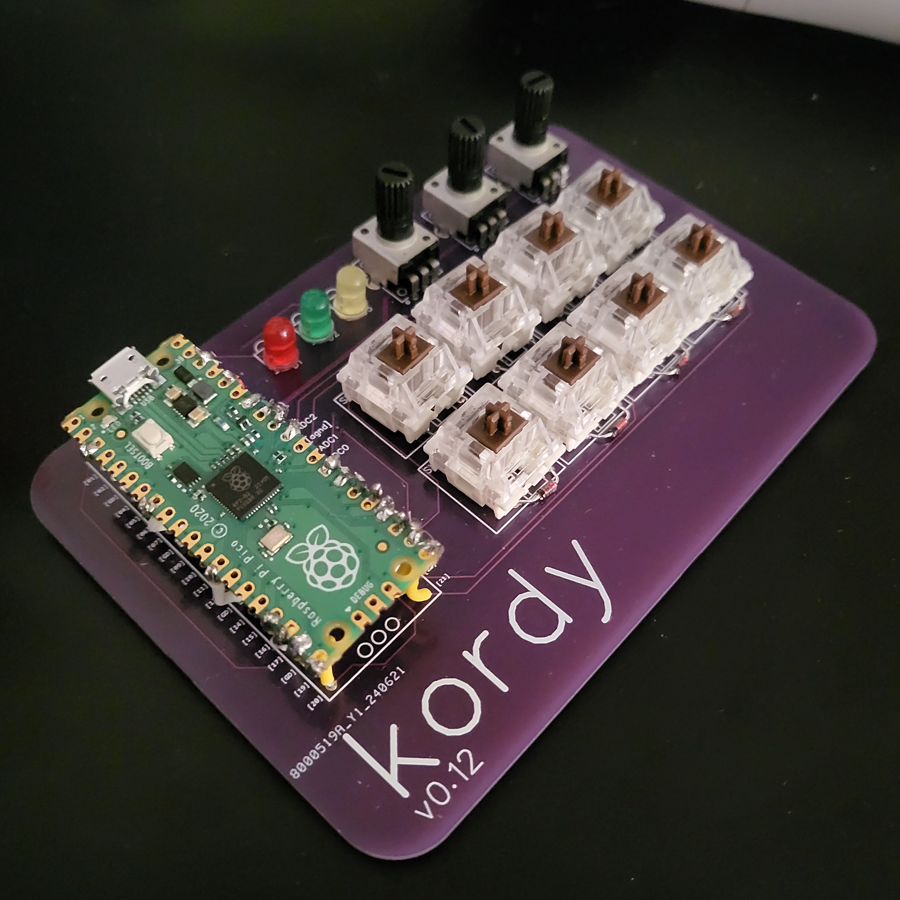
The macro pad had two potentiometers(knobs) and 3 leds. I later turned this into a synth by gluing on a module that turns one of the pins on the microcontrollers(pi pico) into an audio signal via a (1/8) aux jack.
using displays
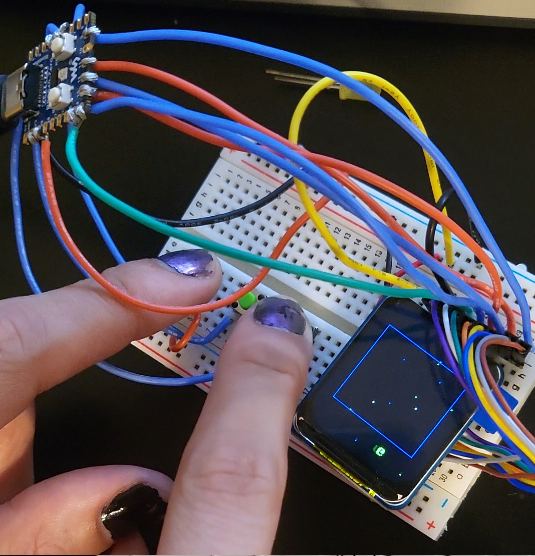
Fully convinced I liked doing this whole hobby I spent a bit more money on more modules, the exciting one being a few displays. Small lesson I learned here though, is to see if the more advanced stuff uses a specific language or platform, for example the display and its controllers I bought, with the language I like to use (CircuitPython) wasn't really supported so it was much more difficult to code with, I had to use MicroPython to get the display working.
other modules
Now more confident in making pcb's I also bought a few other modules I believe could make for more complicated devices. The ideas I usually get are audio synthesis-esque devices.
The few I'm looking forward to using is the SD card and the EEPROM module, both memory but if making a device to last a long time, SD card data can deteriorate, while the EEPROM (while small) can have persistent data up to like 40 years, even when power is removed.
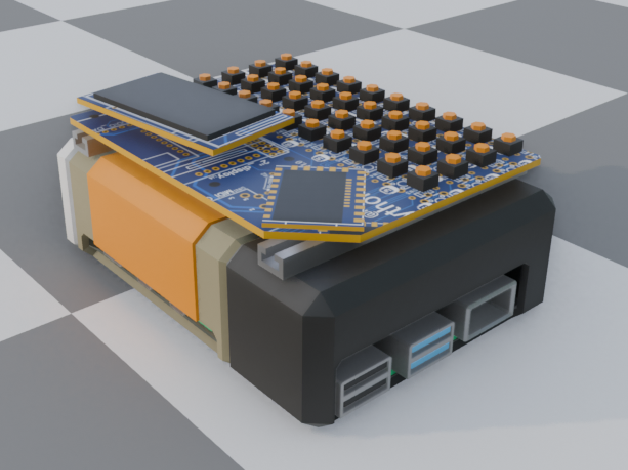
Recently have been wanting to try to design some carrier boards for the zero-format sbc's to make (when i boil it down) hardware apps. From effects pedals to minimal grooveboxes.
reading more bit by bit
While I really like it, this hobby isn't like a burning passion, so progress is a bit slow, its really more of a break from when game development is burning me out.
Further reading
Although I do like to get in the CAD software and make more devices, I also take an effort to casually read through ~~tomes~~ any textbooks that cover electric engineering or like circuits and the like.
Books on microcontrollers are *in my experience* kinda bad? When searching for literature with keywords like "sbc, microcontrollers, raspberry pi, arduino", the kinds of things you get are e-books with the same concepts. Macro keyboard, Arcade cabinet Emulator, pi-hole, Midi Controller.
Where I find the most interesting and eye-opening stuff are like used ~~tomes~~ textbooks about Circuits or Electrical Engineering. More fundamental stuff I should've started with but I kinda like how I ended up to this point. I kinda think its more fun tbh
Just the other month I learned that placing capacitors and wiring them to the power can make it so that your microcontroller has more stable power (pretty important for audio stuff). There's some dude who's even using capacitors instead of batteries to power LED stuff.